The Khangar Kshatriya community has always known its own history — oral traditions, family genealogies maintained by Bhats and Vahivanchas, and centuries of lived Rajput customs have preserved the memory of their Chandravanshi origins. But in an age where written documentation carries weight, it becomes important to present the independent, third-party evidence that colonial-era British administrators themselves compiled about the Khangar community.
These records — gazetteers, ethnographic surveys, census reports — were not written by Khangars. They were compiled by British civil servants whose job was to classify and document every community in India. When these outsiders, with no stake in the matter, recorded the Khangar-Rajput connection as credible, it constitutes powerful independent evidence.
This article brings together every significant colonial-era reference to the Khangar community's Kshatriya status, drawn from published government records that are today available in national archives, university libraries, and digital repositories.
W. Crooke — Tribes and Castes of the North-Western Provinces and Oudh (1896)
William Crooke (1848–1923) was a British ethnographer and Indian Civil Service officer who spent decades studying the communities of the North-Western Provinces (present-day Uttar Pradesh). His four-volume work, published by the Superintendent of Government Printing, Calcutta in 1896, remains one of the most cited references on Indian communities from the colonial period.
Crooke's entry on the Khangar community is remarkably significant. He made three key observations that directly support the community's Kshatriya identity:
First, he recorded that the Khangar claim to Rajput lineage is supported by many legends and traditions — not one or two isolated stories, but a consistent body of oral history pointing in the same direction.
Second, he acknowledged that there is undoubtedly a genuine connection between the Khangar and Rajput communities. This is not a speculative remark — Crooke used the word "undoubtedly," indicating that even a skeptical colonial observer found the evidence convincing.
Third, and most importantly, Crooke concluded that it is "much more likely" that the Khangar descended from Rajputs, rather than the reverse. In his own assessment, the direction of lineage runs from Rajput to Khangar — exactly as the community's own genealogies have always maintained.
This assessment carries particular weight because Crooke was not sympathetic to caste claims by default. His work documents hundreds of communities, and he was often skeptical of origin stories. The fact that he found the Khangar-Rajput connection convincing enough to endorse speaks to the strength of the evidence he encountered.
Crooke's work is freely available today through Project Gutenberg, Internet Archive, and the Indian Culture portal of the Government of India. Anyone can verify these references independently.
R.V. Russell — Tribes and Castes of the Central Provinces of India (1916)
R.V. Russell, an Indian Civil Service officer who served as Superintendent of Ethnography for the Central Provinces, compiled another major ethnographic survey with the assistance of Rai Bahadur Hira Lal. Published by Macmillan and Co., London in 1916, this four-volume work covers communities across what is today Madhya Pradesh — the very heartland of Khangar settlement.
Russell's survey is particularly valuable because the Central Provinces included the core Bundelkhand region where the Khangar community had its historical seat of power at Garh Kundar. His documentation of the Khangar community in this region provides a second independent British confirmation of their historical presence as a ruling and martial community.
The significance of Russell's work lies in the fact that it was commissioned "under the orders of the Central Provinces Administration" — making it an official government publication, not a private opinion. The descriptions of communities in this survey directly informed colonial administrative decisions about land rights, judicial privileges, and social recognition.
D.L. Drake-Brockman — Jhansi District Gazetteer (1909)
The district gazetteers compiled for individual administrative units provide the most granular evidence of the Khangar community's historical presence. D.L. Drake-Brockman's gazetteer for the Jhansi district, published in 1909, is especially relevant because Jhansi lies at the heart of the Bundelkhand region where Khangar rulers held power.
District gazetteers typically documented each community's traditional occupations, social standing, landholding patterns, and historical role. The references to Khangar families in the Jhansi gazetteer place them in the context of ruling clans and landholding communities — categories that, in the colonial administrative framework, were associated with Kshatriya/Rajput status.
Similar references appear in the gazetteers of Hamirpur, Banda, and other Bundelkhand districts where the Khangar community has a significant historical presence.
The Imperial Gazetteer of India — Bundelkhand Entry
The Imperial Gazetteer of India, compiled under the direction of William Wilson Hunter and published by Trübner & Co., London, was the most authoritative geographical and administrative reference produced during the British period. Its entry on Bundelkhand discusses the succession of ruling dynasties in the region.
The narrative of Bundelkhand's political history as recorded in the Imperial Gazetteer follows a clear sequence: the Chandela dynasty (builders of Khajuraho), followed by the Khangar dynasty (rulers of Garh Kundar), followed by the Bundela dynasty (founders of Orchha). This placement of the Khangars as an independent ruling dynasty — positioned between two universally recognised Rajput dynasties — is itself powerful evidence of their Kshatriya status.
No one disputes that the Chandelas were Rajputs. No one disputes that the Bundelas were Rajputs. The Khangars ruled Bundelkhand between these two dynasties, from the same fort, over the same territory. The Imperial Gazetteer treats them as part of the same continuum of Rajput rule.
Garh Kundar Fort — The Physical Evidence British Surveyors Documented
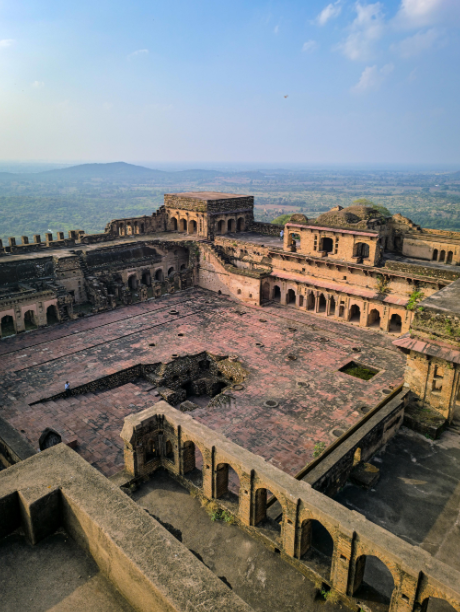
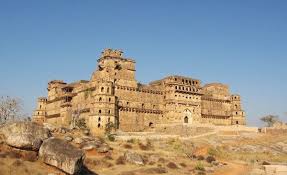
When British surveyors reached Garh Kundar, they documented a fortress that even by colonial-era standards was considered exceptional. Located in present-day Niwari district of Madhya Pradesh (approximately 70 km from Jhansi), the fort exhibits features that are unmistakably the work of a powerful ruling dynasty.
The fort has five stories — three above ground and two underground. It includes elaborate subterranean chambers, strategic defensive passages, a large central courtyard, and 21 gazebos. Rock and pillar inscriptions found within the fort record the history of the Khangar dynasty, including the account of Princess Kesar De's jauhar (self-immolation to protect honour) — a practice historically associated exclusively with Kshatriya Rajput royal women.
British surveyors noted that the fort is constructed from sandstone, bricks, and lime, spanning approximately one hectare of hilltop terrain. Its architectural sophistication — including the famous optical illusion where the fort is clearly visible from 5 km away but seems to disappear as one approaches it, with the road diverting in other directions — demonstrates advanced military engineering.
The construction and maintenance of such a fortress over centuries requires enormous resources, skilled labour, administrative infrastructure, and sustained military capability. These are the hallmarks of a Kshatriya ruling dynasty, not a subordinate community.
The renowned Hindi novelist Vrindavan Lal Verma documented the fort's history in his novel "Garh Kundar," further establishing it in the literary and historical consciousness of Bundelkhand.
The Khangar Dynasty Timeline — As Recorded in Colonial Sources
Colonial records, when cross-referenced with indigenous genealogies, establish the following timeline of Khangar rule in Bundelkhand:
circa 1180 AD — Maharaja Khet Singh Khangar, born in the royal family of Junagadh, Gujarat (son of Ra Kawat II of the Chudasama dynasty), serves as a trusted commander of Prithviraj Chauhan. After the Mahoba war against the Chandelas, Prithviraj appoints Khet Singh as the ruler of Garh Kundar and the surrounding region of Jijhotkhand (Bundelkhand).
1192 AD — After Prithviraj Chauhan's defeat at the Second Battle of Tarain, Khet Singh's successor declares independence and establishes the Khangar kingdom as a sovereign state.
1192–1347 AD — Five generations of the Khangar dynasty rule from Garh Kundar. During this period, the Jinagarh Palace is fortified and renamed as Garh Kundar fort by Maharaja Khub Singh Khangar. The kingdom functions as an independent Rajput state in the heart of Bundelkhand.
1347 AD — Muhammad bin Tughlaq captures the fort. The last Khangar ruler, Nagadev, falls in battle. Princess Kesar De performs jauhar. The fort passes to the Bundela dynasty.
This 150+ year dynasty — ruling from a major fort, fighting battles against sultanate armies, with its princesses performing the distinctly Kshatriya practice of jauhar — is not the history of a community claiming Rajput status. It is the history of a community that was Rajput.
The Prithviraj Raso Connection
The Prithviraj Raso, composed by the court poet Chand Bardai, is one of the most important literary sources for the history of 12th-century north India. This epic poem mentions Khet Singh Khangar as a commander and trusted general of Prithviraj Chauhan.
This reference is significant for two reasons. First, a commander serving directly under Prithviraj Chauhan would necessarily have been of Rajput/Kshatriya rank — the Chauhan court did not appoint non-Rajputs to senior military command positions. Second, the mention in Prithviraj Raso places Khet Singh alongside other recognised Rajput chiefs of the era, implicitly affirming his equivalent status.
The Alha Khand, composed by the poet Jagnik, provides a parallel account of Khet Singh's military campaigns in Bundelkhand, further corroborating his role as a Rajput warrior-chief.
Census Records and Caste Classifications
The British census system, which began systematic operations in 1871 and continued through 1931, classified Indian communities into various categories. The census operations of 1891, 1901, and 1911 are particularly relevant because they coincided with the period when the ethnographic surveys discussed above were being compiled.
The census classification of the Khangar community in Bundelkhand-region districts consistently placed them within the broad category of landholding martial communities — the same administrative category that included recognised Rajput clans.
It should be noted that the British census system was not always consistent or fair in its classifications. Many communities that were historically Kshatriya were reclassified based on economic status during the colonial period. However, even within this imperfect system, the Khangar community's martial and landholding status was documented.
The Chudasama Connection — Verified Through Colonial Records
One of the most critical pieces of evidence is the Khangar community's connection to the Chudasama dynasty of Junagadh, Gujarat. The Chudasama dynasty is universally recognised as a Yaduvanshi (Chandravanshi) Rajput house. The Bombay Gazetteer and Gujarat-specific colonial records document the Chudasama dynasty's history extensively.
The Khangar community's genealogical records, maintained by Vahivancha (bardic genealogists), trace their origin to Ra Kawat II of the Chudasama dynasty, who ruled Junagadh from approximately 1140–1152 AD. His son Khet Singh — born in 1140 AD — was the same Khet Singh Khangar who went on to establish the Khangar dynasty at Garh Kundar.
This connection is documented from both sides: Chudasama genealogies record Ra Kawat II's sons, and Khangar genealogies trace back to Ra Kawat II. When two independent genealogical traditions — maintained by different communities in different parts of India (Gujarat and Bundelkhand) — point to the same ancestor, the evidence is compelling.
If the Chudasamas of Junagadh are Chandravanshi Yaduvanshi Rajputs (which no historian disputes), and the Khangars descend from the Chudasamas (which genealogical records on both sides confirm), then the Khangars are Chandravanshi Yaduvanshi Rajputs. The logic is straightforward.
Why This Evidence Matters Today
Some may ask: why does colonial-era documentation matter for a community that already knows its own history?
The answer is practical. In today's world, written evidence from neutral third parties carries significant weight — in academic discourse, in administrative processes, and in public perception. The fact that multiple British administrators, across different surveys, different decades, and different provinces, independently documented the Khangar-Rajput connection makes this evidence difficult to dismiss.
Here is a summary of the key sources:
W. Crooke (1896) — Tribes and Castes of the North-Western Provinces and Oudh: Acknowledged Khangar-Rajput connection as genuine
R.V. Russell & Hira Lal (1916) — Tribes and Castes of the Central Provinces: Documented Khangar presence in the Bundelkhand heartland
D.L. Drake-Brockman (1909) — Jhansi District Gazetteer: Recorded Khangar landholding and martial families
Imperial Gazetteer of India — Placed Khangar dynasty in the sequence of Bundelkhand's ruling Rajput houses
Prithviraj Raso (Chand Bardai) — Listed Khet Singh Khangar as a commander of Prithviraj Chauhan
Alha Khand (Jagnik) — Corroborated Khet Singh's military campaigns in Bundelkhand
Taken together, these records establish beyond reasonable doubt that the Khangar community's claim to Rajput/Kshatriya status is not a modern invention. It is a historical reality documented by independent observers for over a century.
Where to Verify These Records
For those who wish to verify these references independently, here are the sources:
W. Crooke's work is available on Project Gutenberg (gutenberg.org), Internet Archive (archive.org), and the Indian Culture portal (indianculture.gov.in).
R.V. Russell's work is available on Project Gutenberg and Internet Archive, as well as the Smithsonian Institution's digital archives.
District gazetteers are available through various university libraries and the National Library of India's digital collections.
The Imperial Gazetteer of India has been digitised and is available through multiple online archives.
We encourage every member of the Khangar Kshatriya community — and every researcher interested in Bundelkhand's history — to access these sources directly. The evidence speaks for itself.
Related Articles on This Site:
Tags :
Khangar Rajput, Khangar Kshatriya, British Gazetteer Khangar, W Crooke Khangar, Garh Kundar history, Khangar caste history, Khangar Rajput evidence, Chandravanshi Khangar, Chudasama Khangar connection, Bundelkhand Rajput clans, Khet Singh Khangar, Khangar dynasty, colonial records Khangar, Rajput lineage Khangar, Tribes and Castes Khangar
Published on khangarkshatriya.com — Preserving and documenting the Chandravanshi Yaduvanshi heritage of the Khangar Kshatriya community.
Comments 0